Ubisoft’s The Division 2 released only a short time ago, and has received a positive reception, currently sitting at an 81% on Metacritic. The loot-shooter market is incredibly crowded at the moment, with Destiny 2, Anthem and Warframe the current titans of the genre (though it’s worth noting that ‘titan’ does not mean ‘good’). The Division 2 is having to compete for players and this demands Ubisoft’s latest release to set itself apart, and tempt players away from the free-to-play Warframe and long standing Destiny.
One of the major criticisms of the first Division game was its politics. Having a government agency enforce the continuity of government after what essentially amounts to an apocalypse is autocratic to say the least. Ubisoft clearly stated they wanted to keep politics separate from The Division 2 as much as humanly possible. Recent years have seen a remarkable amount of backlash to what is perceived as ‘politics’ in games, and Ubisoft evidently wanted to avoid criticism on this front. However, in practice this has created a strangely hollow narrative. The Division 2 consistently brushes past political topics, such as fighting against a corrupt order in Washington DC, or how the intro cinematic asks “did you own a gun? did your neighbour?”, not to mention the battle through a museum display depicting the Vietnam War. The Division 2 is littered with political topics, but the game simply fails to make any commentary at all.
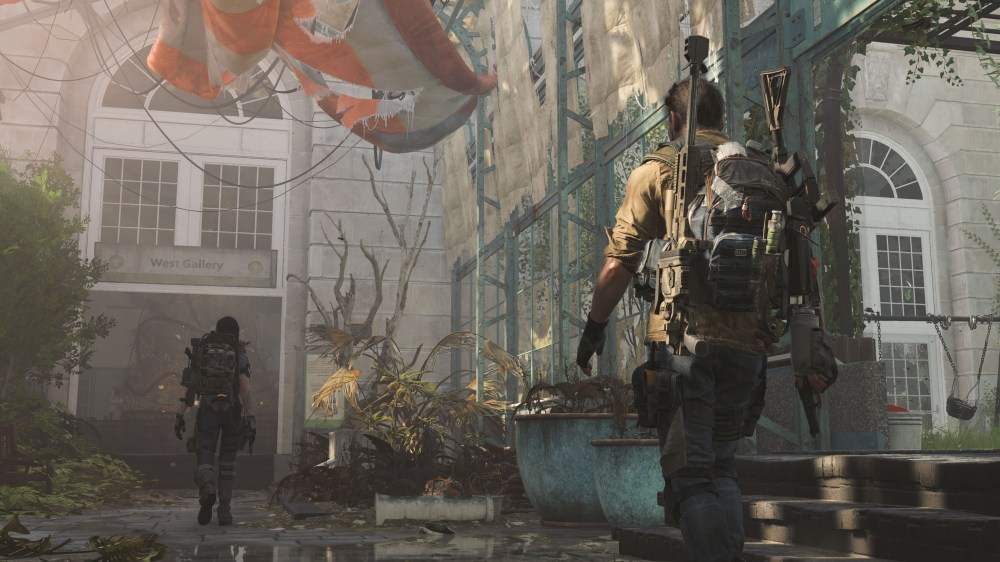
There’s a problem with this approach, attempting to be apolitical in a world which is clearly on the brink is tricky, to say the least. Society has crumbled, but players aren’t asked to question anything. It’s so lacking in commentary, in fact, that The Division actually says quite a lot, but that’s problematic. Asking questions of players is not risky, as art is inherently political, art is a product of those who make it. Yet, saying nothing about a broken and damaged world makes everything seem fine, that you’re a flawless hero.
Despite this, I am really enjoying The Division 2. The gameplay is tight and focused, the missions are well designed, the world is well realised and mostly interesting to explore and navigate. While the story is largely meaningless, MacGuffin heavy, and entirely tone deaf, it chains together the experience better than other games of the genre. However loose the narrative is, it has been used to good effect in mission design. I understand Ubisoft’s reticence to say anything overtly political, and perhaps this approach is better than that of Far Cry 5, which almost managed to say something, before both falling flat and giving up. The focus of The Division 2 is very much on the gameplay, and that focus does end up creating a compelling experience. I can see this title being a consistent feature in my gaming rotation for quite a few months, depending on how I find the endgame experience.
Ultimately, loot-shooters live or die on their gameplay, not their story. The criticism of Anthem’s story pales in comparison of that towards its gameplay loop. The failings of Destiny 2 are largely to do with its gear. The success of Warframe is the richness of its core experience. The Division 2 won’t be remembered for its story, but it will be remembered if it successfully manages to forge Washington DC into the ultimate, co-operative, loot filled playground, and with a year of free extra content planned, I’m excited to see where Ubisoft continue to take it. Maybe the free story content will give The Division a voice, but in the meantime, it’s a glorious, well made romp.
The Division 2 is out now on Playstation 4, Xbox One and PC.

 Oliver Douglas