Count Oliver of Sussex wasn’t a hugely relevant man. Of a small landed house by the name of Douglas, he didn’t have much power in the petty kingdom of Wessex, but he was ambitious. Within ten years of the start of his stint as a landed gentleman, he had deposed one King to place Alfred (Alfred the Great, in actual history) on the throne, before murdering him and his five year old son to take the throne for himself. While this happened, a Viking named Bjorn was besieging Oliver’s territories in the south-east, endangering his game of thrones. Yet, upon becoming King, and inheriting the land that goes with such a title, Oliver surrendered to him and made him the Duke of Kent. Only a short decade or so later, King Oliver ‘the Just’ of Wessex had driven the pagans out of England and formed the first Kingdom of England.

This was just around six hours of playtime of Crusader Kings 2, but it spanned 35 years of my virtual avatar’s climb from count to the first English King. At the same time, my friend was slowly expanding his Sardinian Empire in Italy, and worming his way into the Byzantine political system in order to take control of it. So much can happen in so little of your own time, that you can see a vast historical narrative expand in front of you. I could tell you the story of how Boleslaw Piast of Poland annexed Kiev, or how the King of France married into the English royal family before taking the throne for himself. None of these events played out anything like this in our history, but Crusader Kings’ stories form the same way, through decisions made by individuals.
Crusader Kings 2, a grand strategy game from Paradox Interactive, has been out since 2012, so is a relatively old game. Despite this, it does everything it needs to and more to remain an exceptional experience. With a relatively steep learning curve covering more mechanics than you can imagine, it takes a while to get into it. Yet, once you can play unguided, it opens up a whole world of historical mischief. While I could berate Paradox for their DLC practices, I won’t, because this piece is about why Crusader Kings is one of the best pieces of interactive history available today.
In Crusader Kings, you play as a dynasty, but you are only ever one person at a time, so you, in all respects that matter, are that person while you play. You make the decisions. Whether to assassinate your wife, whether to invade a neighbouring county, or whether to marry your daughter into a foreign dynasty for a strong alliance, and you make all these decisions in the same way genuine historical actors did. You are in the situation of a ruler and are asked to make decisions that rulers would make. It’s the closest any modern person can be to ruling a medieval kingdom.
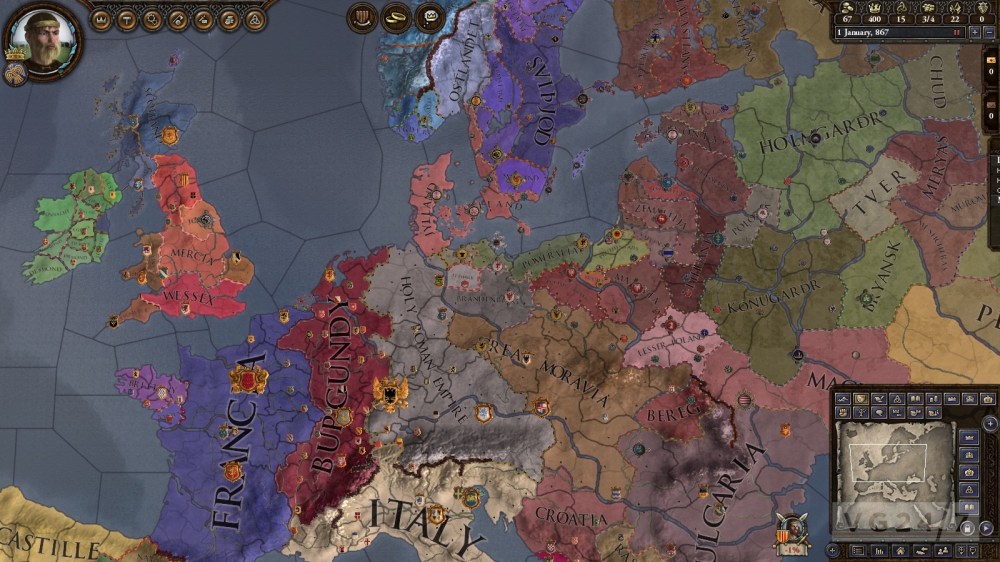
Many historical games are primarily focused on the “accuracy”. People complain if a gun doesn’t look right, or a shield has the wrong colours, or if events are altered for dramatic effect. This is lovely, and historical adaptations have an important place in popular culture, and those adaptations have a duty to be broadly accurate for the sake of not spreading misinformation. However, these adaptations don’t really teach anybody about what history really is, or why anything that happened, happened. It’s the retelling of stories. Games like Crusader Kings (and titles like Total War, especially the original Rome), have a capacity to teach a person how history happens, which is a fascinating lesson. To understand history, we have to understand why people made the decisions they did. Sometimes, it can be hard to do that by just looking at the events and putting them together. That can be too cold, and calculating. It can be far too logical to understand human behaviour. History happened the way it did for a vast range of remarkable, exciting and stupid reasons, and grasping that requires you to imagine yourself in the position of those making the decisions. It becomes a lot easier to understand why a feudal king married his son to a foreign princess who he can’t communicate with if you understand the political ramifications of doing so first hand.
This is not to devalue the importance of accuracy, and Paradox clearly cares about history, and includes countless historical dynasties, characters, events and organisations that influence your play. But outside these core events and families, everything can happen so wildly differently to our own history that the world is unrecognisable by the end of a play-through, so you never feel like you’re repeating yourself. Your dynasty is just one part of a dynamic and changing world, that is held within a framework of just a few important and significant historical events. The possibilities are endless.
As somebody who studies history at an academic level, video games are still an ill-recognised part of popular history, and rarely appear in papers or as the subject of books. They’re not a traditional medium, and that makes the engagement from academic historians less than film or novels. However, while trawling through letters and diary entries in archives is an integral part of academic study (and discoveries made here filter down into more accessible work), the process of understanding how events interconnect through archival material is less available to most people, making popular works which help convey it, all the more important. While film and prose is excellent for narrative history, video games, due to their interactivity, are amazing at allowing audiences to engage with history, rather than to passively consume it.
If you have never played Crusader Kings 2, and either have an interest in history or study it, I suggest picking it up. It’s quite cheap, and the base game is more than enough content to engage you for hundreds of hours. You might find the learning curve off-putting, but after a couple of YouTube videos or even just messing around in-game, you’ll pick it up, and you’ll be able to tell your own dynastic story, just like I can.
Tweet me @osdouglastweets if you pick up Crusader Kings! I want to hear your characters’ stories!

 Oliver Douglas